Succession planning activates talent in a school district by providing leadership opportunities at all levels and has been shown to positively impact leadership tenure as well as human and social capital, write contributors Brian Sheehan, Marc Ferrara, and Carolyn Vanasse. They offer advice on how succession planning can be a productive and achievable process in your district.
September 15, 2026
 REESE/PEOPLEIMAGES.STOCK.ADOBE.COM
Ever felt underused in the workplace? Whether you know it or not, your district is filled with people who feel underused, underrated, or unheard in their current position.
Underemployment contributes to employee shortages, burnout, stress, turnover, absenteeism, job dissatisfaction, and impedes organizational effectiveness. Our 2025 national survey of current board members, Succession Planning and Sustainability (SPAS), was developed to collect data from board members to identify the extent to which their superintendents are: (1) identifying and mentoring internal leadership talent, (2) creating opportunities for leadership development, and (3) providing data on developed leaders. A mixed-methods design with a predominantly quantitative survey research frame was used, as neither method would satisfactorily address the complexity of the issue by itself. We conducted research at the NSBA 2025 Annual Conference in Atlanta; the total number of participating school board members was (N=147). A questionnaire was distributed to collect data for the quantitative portion of the study using Thought Exchange; 147 completed questionnaires were returned.
Leadership roles motivate employees to contribute their maximum effort, skills, and knowledge. Succession planning activates talent in the district by providing leadership opportunities at all levels and has been proven to positively impact leadership tenure as well as human and social capital. How can succession planning be a productive and achievable process in your district? What should be your first step(s) to bringing succession planning practices to your district? The following are some ideas to help you implement succession planning.
1. Where Are You and Your Board?
Our 2025 board member responses indicated a majority of districts do not have a formal superintendent succession planning process. Some districts acknowledge the need for such a plan, citing issues like short superintendent tenures and the importance of smooth transitions. A handful of districts had informal or verbal plans, and even fewer were in the process of developing one. Only a small number of districts have a documented, systematic process in place. Which of the following statements do you feel you and your board identify with?
2025 Board Members on Succession Planning
- “We have a process but not a formal, written plan.”
- “Not having a succession plan hurts our district. I wish we did.”
- “We encourage our superintendent to identify up-and-coming leaders and look for district employees that are doing well and encourage their skills. I wish our board had this information in writing.”
- “We are finally working to get our board “on board” to develop a formal succession planning program.”
- “We require our superintendent and directors to each create leadership opportunities at all levels and update us on this work.”
- “We expect development from within to be in the DNA of the district. We find ways to recognize talent and then don’t let the scope of the job threaten them.”
- “We expect the superintendent to identify and mentor internal leadership talent, create opportunities for leadership development, and provide data on developed leaders. I wish our superintendent were doing more towards this goal.”
- “We ask our superintendent to create programs to cultivate district talent and maintain a succession plan with both internal and external candidates. She is also required to create a monthly list of expectations for the board to consider.”
- “Identify prospects and provide them with active mentoring; mentoring is very important. The superintendent is in the school day-to-day and is better positioned to identify prospects than board members.”
- “It’s the chief school administrator’s responsibility to ensure a succession plan. We do not know what it is, however.”
- “Superintendents should proactively identify, mentor, and develop internal leadership talent, ensuring that future leaders are embedded within the district. Not just their district leadership team.”
- “If our superintendent does not have the time to create opportunities and cultivate educational leaders to fill leadership vacancies, I believe they should provide this task as a leadership opportunity for interested district personnel.”
- “Districts should have internal learning for each level of leadership to have shared knowledge of what each other does. We do not currently have that, but I am advocating for it.”
- “A succession plan should be evaluated every year by the board.”
- “We have an administrator pipeline, helping our admins learn how to get to the next level. We don’t have a specific plan for superintendent replacement.”
- “We have a deputy superintendent that is being evaluated for the job, but I don’t think we have a plan beyond that. There are only so many qualified superintendents out there. Don’t want to be scrambling to find one!”
- “Cultivating internal leadership is critical. Our board is always looking for ideas.”
- “Short tenures for superintendents: 2- to 3-year average. Need to have a ready-to-go plan to keep teachers and admin progressing forward.”
- “We do not have a written plan, only a verbalized plan by the superintendent.”
- “We made succession planning part of our superintendent’s evaluation each year, and we discuss it regularly.”
2. Succession Planning Indicators
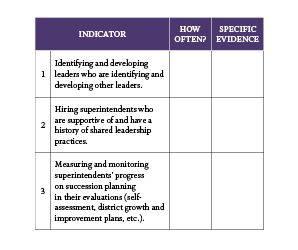
Every district is different. Understanding the importance of a superintendent’s broad functional abilities and career growth rate in your district is imperative. Creating and sustaining professional development pipelines aligned with succession goals and district priorities must be a regular topic of conversation. Ensuring internal learning at each leadership level and evaluating succession plans annually are also crucial actions. Here are some indicators one board listed to hold itself accountable.
3. Look to Create a Districtwide Culture of Development
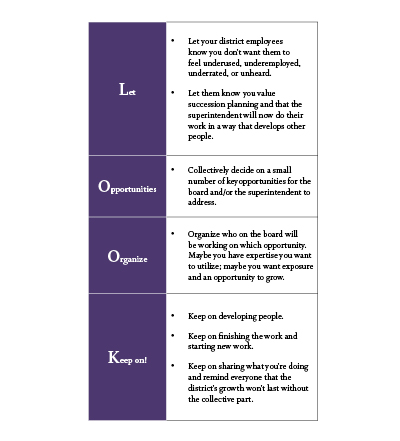
To bring succession planning practices to the district, respondents suggest meeting with administrators to help them understand their career goals, ensuring districtwide support, and creating leadership opportunities. They emphasize the importance of internal development, recognizing and nurturing talent, and integrating succession planning into superintendent evaluations. Additionally, they recommend discussing the initiative at strategic meetings, assessing current practices, addressing leadership gaps, and mentoring internal candidates. We suggest the acronym LOOK:
4. Superintendent Evaluation
School board members should expect superintendents to identify and mentor internal leadership talent, create opportunities for leadership development, and provide data on developed leaders. Superintendents should prepare the district for continued development, foster programs to cultivate local talent, and maintain a succession plan with both internal and external candidates. They also should create a monthly list of expectations for the board to consider. All of this should be included in their self-evaluations, board review and evaluation, goal setting and planning, as well as their summative evaluation.