For most of the last decade, districts across the country have built paper versions of the high school student who is ready to walk across a graduation stage.
Dubbed “portrait” or “profile” of a graduate, these documents are designed to guide districts in preparing each young person in their charge for a world where they’ll need to think critically, solve problems, and communicate clearly.
It’s no easy feat to define what it means to truly prepare our students for success in postsecondary education, the workforce, or society. Harder still is the question of whether our students are arriving anywhere near that definition.
In fall 2025, The New York Times reported on what awaits students who leave school without these skills beneath the ominous headline “What Declines in Reading and Math Mean for the U.S. Work Force.” Selective colleges are now watching students lose the stamina to read a long article. Technical colleges are adding “fundamentals” classes so students training for the trades can keep up.
The thread running throughout is a lack of foundational skills, reading most of all, that plagues America’s economy.
That thread is one that ties the portrait your own district has drawn directly to your first grade classrooms, where every skill it names is built. A child who cannot read fluently cannot think hard about a text, research a question, or write a clear argument, which is most of what the picture promises.
Research shows that a child’s reading at the end of first grade now predicts, with real accuracy, whether that child will graduate at all. A forecast set that early is also one a district can still rewrite.
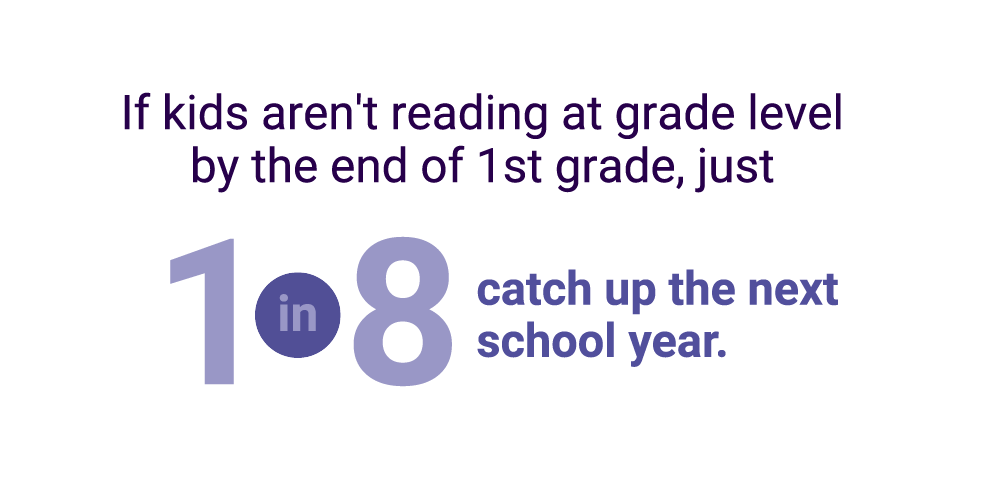 WHEN CHILDREN FINISH FIRST GRADE BEHIND, FEW CATCH UP ON THEIR OWN. IN THE JOHNS HOPKINS STUDY, ONLY ABOUT 1 IN 8 REACHED GRADE LEVEL THE FOLLOWING YEAR. COURTESY OF IGNITE READING
When one year changes everything
What does it look like when a school acts that early, while the picture can still change? To Amie Akuma, it looks a lot like a fourth grader named Mateo.
Akuma is principal of Korematsu Discovery Academy, an elementary school in California’s Oakland Unified School District. Almost every student qualifies for free or reduced-price lunch and about 40% are still learning English.
When Mateo arrived at the start of first grade, a screener flagged that he was more than a full grade behind in reading. He began receiving intensive, one-to-one early literacy intervention. The virtual 15-minute sessions were built into his regular school day. Day by day, he made up for lost ground and caught up to his peers. By second grade he needed only light support. By third grade, none. By fourth grade, his name consistently appeared on the list of his classroom’s top readers.
Mateo was part of the school’s first group of first graders to receive this one-to-one help, and the entire cohort has held grade level in the years since.
“It wasn’t just a one-year fix,” Akuma says. “It helped them stay on track, and they’re thriving now. One year changed everything for them.”
Mateo got the version of this story many families assume is normal. But for most first graders who fall behind, the line continuously bends away from the graduate that portrait was meant to describe.
Reading gaps that compound
Consider where that other story leads. The latest reading results for America’s high school seniors are the worst the country has ever recorded. Results released in fall 2025 from the National Assessment of Educational Progress show 12th grade reading scores have fallen to their lowest point in the more than three decades the assessment has existed. Nearly a third of high school seniors cannot read at even a basic level.
Those seniors were first graders once, just like Mateo. For most of them, the gap that surfaced on a 12th grade test was visible by the time they were 6.
Tracking backward from their graduation year, we spot the warning lights flashing in middle school. Johns Hopkins University researcher Robert Balfanz and his colleagues found that three sixth grade indicators—attendance, behavior, and a failing grade in math or English—together identify roughly 60% of the students who will not graduate.
We can identify most future nongraduates while they are still 11 years old, sitting in sixth-period English language arts, but we know this trouble does not begin in sixth grade. A child who cannot read fluently struggles to keep up in every subject, falls behind, stops showing up, and acts out. The attendance issues and the failing grade are often a reading problem dressed up in a different costume.
Follow a student’s path back in time and you’ll find those same warning lights flashing at repeated junctures.
A 2011 longitudinal study from the Annie E. Casey Foundation, following nearly 4,000 students, found that children who are not reading proficiently by the end of third grade are four times more likely to leave high school without a diploma. A student who is both behind in reading and growing up poor is six times less likely to graduate on time. For Black and Latino students carrying both, the gap widens to eight times.
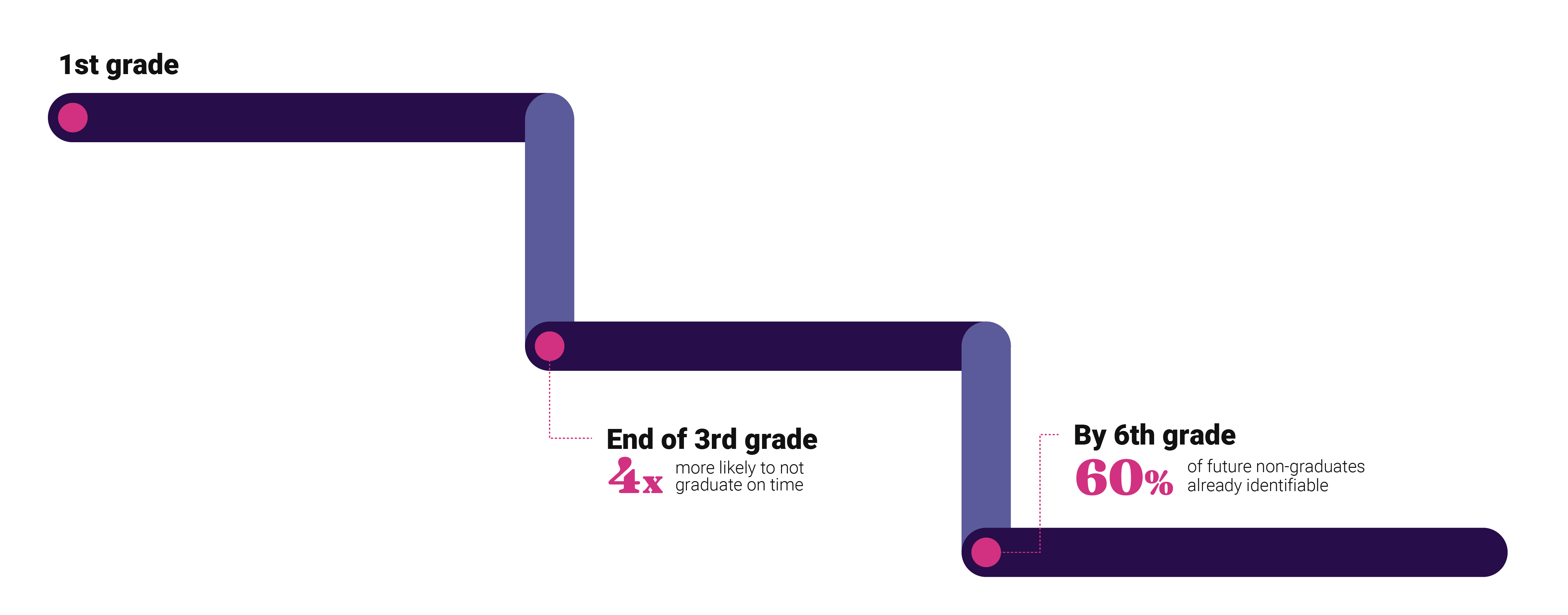 A FIRST GRADE READING GAP COMPOUNDS. BY THE END OF THIRD GRADE, A STUDENT BEHIND IN READING IS FOUR TIMES MORE LIKELY NOT TO GRADUATE ON TIME, AND BY SIXTH GRADE, 60% OF FUTURE NONGRADUATES CAN ALREADY BE IDENTIFIED. (SOURCES: ANNIE E. CASEY FOUNDATION; JOHNS HOPKINS UNIVERSITY) COURTESY OF IGNITE READING
Step back even further to the early grades, and you reach where the first warning light blinks on, the one with the most time left to act.
The newest evidence shows how fast that time runs out. In 2026, NWEA reported on more than 400,000 children it had tracked from the start of kindergarten. A struggling kindergartner still had a 1 in 10 chance of reading proficiently by third grade. A child still behind at the end of first grade had just 1 in 50. The most striking finding, the study’s lead researcher said, was how quickly that chance disappeared.
The far reach of first grade
First grade is when children are developmentally most ready to learn to decode words, and it is the cheapest, most effective time to catch a child who is slipping. Wait until third grade, when the curriculum shifts from learning to read to reading to learn, and you are no longer preventing a problem. You are trying to reverse one, with worse odds and a higher price.
Third grade has become a national accountability checkpoint where states test, retain, and intervene. But a checkpoint is a barrier, not an open window. By third grade, we are measuring damage that a first grade investment could have prevented.
A reasonable objection to this strategy is that first grade may be too early to tell who needs help or that whatever gains you produce will wash out. However, the research shows the opposite is true.
Researchers at the Center for Research and Reform in Education at Johns Hopkins University recently completed a two-year evaluation of a high-dosage, one-to-one early reading intervention across 13 Massachusetts districts. The study matched tutored first graders against similar students who were not tutored, then followed both groups of students into second grade.
In the interest of full disclosure, the intervention in that study is operated by my company, Ignite Reading. It is the same virtual daily intervention that changed Mateo’s trajectory in Oakland. The evaluation itself was independent, conducted by Johns Hopkins researchers and funded by the philanthropic One8 Foundation.
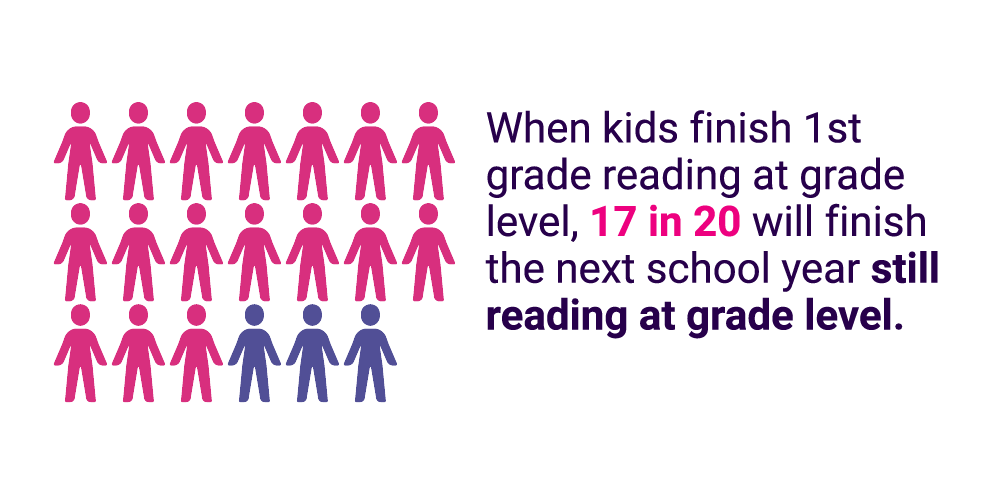 WHEN CHILDREN FINISH FIRST GRADE READING ON GRADE LEVEL, THE GAIN HOLDS. IN THE JOHNS HOPKINS STUDY, 17 OF EVERY 20 WERE STILL READING ON GRADE LEVEL A YEAR LATER, WITH NO EXTRA HELP. COURTESY OF IGNITE READING
Among first graders in the Johns Hopkins study who reached reading proficiency with the help of early literacy intervention, 85% — 17 in 20 students — were still reading on grade level a year later with no further help. Among those who finished first grade still behind, just 1 in 8 caught up on their own.
Picture two children in the same first grade classroom in June, one just over the line and one just under it. A year later, the first is almost certainly still on track, and the second almost certainly is not. Now consider the scale of what moved in that one year of intervention.
The share of first grade students reading at benchmark rose from 6% to 48%. At the same time, the share needing intensive intervention fell from 70% to 31%. The gains held across English learners and students with disabilities alike, and the overall effect size matched what research shows the best large-scale in-person tutoring programs achieve, without needing to put a tutor in the classroom.
We see the tide beginning to shift. Districts are already making Ignite Reading’s First Grade Promise to their students, a pledge that they all will have the support necessary to learn to read on time, before small gaps compound. In Chelsea, Massachusetts, a community where most students are multilingual learners, Superintendent Almudena Abeyta has described the tutoring intervention as a seamless extension of her own teachers, providing intensive support the district could not staff on its own. Red Bluff Elementary Union School District in rural Northern California has joined the same commitment, as has the Savannah-Chatham County Public School System in Georgia.
These three districts are linked by a decision to treat reading on grade level by the end of first grade as a promise the adults make to every child.
The decision in front of you
Everyone agrees that early reading matters. The question is where in a student’s timeline your district dollars can do the most work to support their path to become the graduate in your portrait. The evidence points earlier than most budgets currently reach.
Before you approve a literacy line item, consider: What happens when a first grader falls behind in reading—and how fast? If your district shifted your most intensive support down to first grade, what would it cost, measured against what you’re already spending to remediate, retain?
The seniors behind those record-low scores cannot get that year back. The first graders still can. They are your class of 2038. Their portrait is your promise to them.
Jessica Reid Sliwerski (jessica.sliwerski@ignite-reading.com) is the chief executive officer and co-founder of Ignite Reading, a science of reading-based early literacy intervention program.