Keeping the Main Thing the Main Thing
Meet Colorado's Harrison School District 2, recognized with the Council of Urban Boards of Education (CUBE) 2025 Award for Urban School Excellence, and Erika Mitchell, a member of the Atlanta Public Schools Board of Education and recipient of the 2025 Benjamin Elijah Mays Lifetime Achievement Award.
January 19, 2026
 A 2025 HARRISON SCHOOL DISTRICT 2 GRADUATE OF SIERRA HIGH SCHOOL.
PHOTO COURTESY OF HARRISON SCHOOL DISTRICT 2
Under the shadow of Colorado’s Pikes Peak, Harrison School District 2 is demonstrating how a highly diverse, high-poverty urban school district can achieve success for its students, staff, and community.
Problems aren’t viewed as roadblocks in the nearly 13,000-student, majority-minority school system, but as “invitations to innovate,” says Superintendent Wendy Birhanzel. And innovate is what the school district (referred to as D2) is doing for its southeast Colorado Springs community. For example:
- Through intentional efforts to remove barriers to student success, the district provides breakfast, lunch, school supplies, field trips, tutoring, athletic participation, and access to advanced coursework at no cost to district families.
- All district graduates are eligible for two years of free college tuition at Pikes Peak State College (PPSC) through the D2 Promise Scholarship Program.
- Voted Best K-12 Workplace in Colorado Springs (home to 17 local school districts), D2 staff retention most recently reached 87% and administrator retention hit 91%, the highest in the state.
- Student Success Centers in every secondary school help address disciplinary disparities by replacing punitive responses like suspension and expulsion with restorative practices that teach behavior and expectations. With this support, behavior referrals have decreased by 70%, and expulsions have declined by 86%.
In all efforts, D2 “keeps the main thing the main thing, and that’s the children,” says Michelle Wills-Hill, the 2025 Harrison Board of Education president. “It’s always about them. It’s not about personalities or politics. It’s about making sure that we honor diversity and that we are intentional in delivering the best educational opportunities for all students.”
For its accomplishments, Harrison School District 2 was recognized in September with the 2025 Award for Urban School Excellence by the National School Boards Association’s (NSBA) Council of Urban Boards of Education (CUBE). The award, which honors distinction in school board governance, academic improvement, educational equity, and community engagement, was presented during the 2025 CUBE Annual Conference in Los Angeles.
“The Harrison School District 2 Board has demonstrated that visionary governance, clear priorities, and collaboration with the community can transform student outcomes,” said Joel Rodriguez, CUBE chair and a member of the School City of East Chicago Board of Trustees in Indiana. “Their leadership ensures that students are at the center of every decision, that barriers to success are addressed, and that every opportunity is maximized.
“The work of the Harrison School District 2 Board demonstrates what it means to lead with purpose and vision,” said Verjeana McCotter-Jacobs, NSBA Executive Director and CEO. “By creating systems that support educators and open doors for every student, they embody the kind of transformative governance that strengthens communities and advances public education nationwide.”
UNIQUE LITTLE POCKET
Central to the district’s success has been the school board’s ability to govern with transparency, leave politics out of the equation, and respect the lines between board work and superintendent work, Wills-Hill says. “If you honor and respect and don’t cross those lines, I think you have better-built relationships.”
Since 2010, the D2 Board of Education has followed the Coherent Governance model to guide its work, defining the board’s values in policy and giving the superintendent, as the educational expert, the freedom to manage the district in alignment with those values. “The board sets policy and expectations,” Hills Wills explains. “The superintendent executes and leads the operations. The clear roles, the shared goals, and trust in our leadership drive the results.”
Some might not initially think of D2 as an urban school system. Even Superintendent Wendy Birhanzel admits to being a bit surprised when she first considered relocating from California nearly 20 years ago as a principal dedicated to working in urban education. She soon learned, however, that the district is “a unique little pocket” in the generally affluent city of Colorado Springs, “with very urban characteristics.”
D2 stands as the only Title 1 school district in the city. About 75% of students qualify for free and reduced-price lunch, and nearly 75% are identified as minorities (54% Hispanic, 12% Black, 8% two or more races). About 26% receive special education services, and 25% are identified as English language learners who speak more than 55 languages.
At a time when some communities are closing doors to certain groups of students and families, D2 is intentional about welcoming them “because everyone deserves a quality education, and we believe diversity makes us stronger,” Birhanzel says.
Noting that in key academic measures, students in D2’s highly diverse schools outperform similar peers statewide and that graduation rates are up 3.2% over the last five years, she adds, “We have high expectations, but we have high support. We really believe that every student can achieve at their own level, and every kid needs to have the doors to access taken down. That’s our job, which is a hard job to do, but we provide resources and systems to make that happen.”
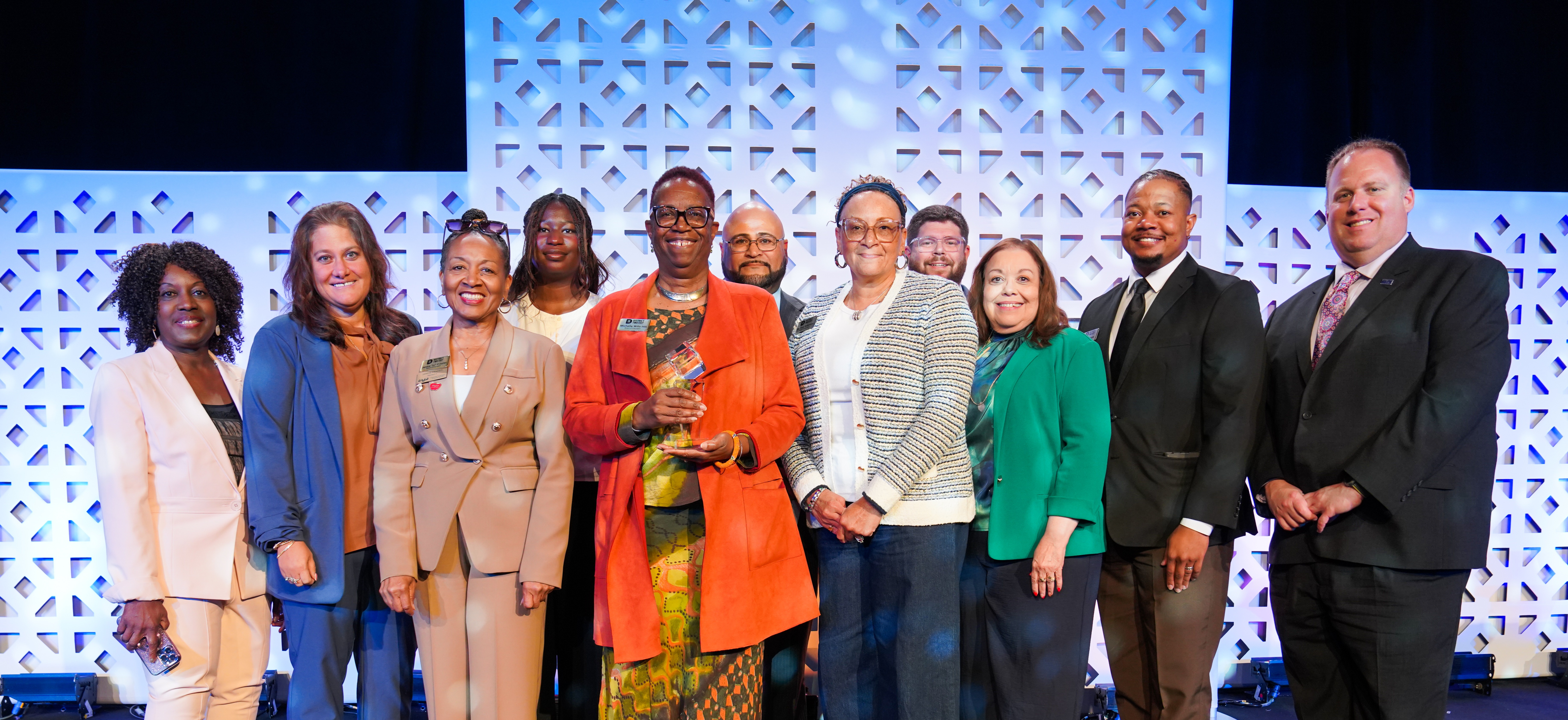
HARRISON SCHOOL DISTRICT 2 REPRESENTATIVES ARE JOINED BY NSBA LEADERSHIP AT THE 2025 CUBE CONFERENCE AWARDS CEREMONY.
PHOTO CREDIT: NSBA
A CULTURE OF FAMILY
Despite statewide studies showing that Colorado schools are significantly underfunded, D2 continues as best as it can to support students and families with various no-cost participation opportunities and ensure mental health counseling, food security programs, housing assistance, and more. “The funding is an absolute issue, so our budget has to determine what we put first,” Birhanzel says, “and we put those opportunities for kids first.”
D2 functions very much as a community school district, she adds, working with local churches, businesses, and other organizations that can help it close the gaps it faces. The board of education, for example, has approved the development of affordable teacher housing on school district land. We Fortify, a “social impact community builders” organization, is constructing two tiny home communities on the property to help attract and retain new teachers. High housing costs in the region have been shown to push many qualified teachers out of the area and out of the profession entirely.
Wills-Hill credits Birhanzel with the district’s ability to support staff and open opportunities for all students by emphasizing “a culture of family” and “honoring the work of everyone” who makes the district succeed. “There’s no big i’s and no little you’s,” Wills-Hill says. “When people have that sense of family, I think they operate from a much different space.”
District constituents have demonstrated their support for D2. In 2018, voters approved a $180 million bond, the first successful bond to pass in nearly two decades. It enabled D2 to rebuild three schools and provide various improvements to the remaining 16 school buildings.
In 2024, voters approved a $9 million mill levy override to increase teacher salaries, enhance educational resources across all schools, and sustain the D2 Promise Scholarship Program (D2 Promise).
The nation’s first publicly funded first-dollar Promise program, D2 Promise pays for all tuition and fees for two years at PPSC and allows district graduates to use federal and state financial aid to cover living expenses. Students can earn an associate degree, transferable credits to a four-year school, or an industry-recognized certificate. They also receive dedicated Promise coaches, academic support, and student success programming. The extended assistance is critical for helping first-generation college students navigate the intricacies of college, Birhanzel says.
The resounding yes on both tax measures emphasized just how much the community values education and its trust in the school system, she adds. “They know we will use the money for what we said we’re going to use it for, and they trust us with their kids. Those are huge wins for our community.”
The story of D2 wasn’t always so glowing. It was once “a place you only went to work as a teacher if you couldn’t get hired somewhere else, and a place you only sent your kids if you couldn’t take them somewhere else,” Birhanzel recalls. “It was considered unsafe, low-academic standards, low-support.” After leading dramatic turnaround efforts at two D2 schools and serving in a central office position, she was named superintendent in 2019.
Early in that leadership role, she, her administrative team, and the board talked a lot about how to change the perception of the district and tell an accurate, current story. One battle they faced was “this mindset or mentality” of what a diverse district means.
“We really did a lot of work about changing the narrative, telling our story, and that means both good and bad,” says Birhanzel. She’s often quoted as saying, “We own our ugly.” Without acknowledging the district’s challenges, she explains, “We can’t move forward and change,”
Students, families, and community partners are not just bystanders to the success taking shape in D2, adds Wills-Hill. “We think that they’re actually co-authors of our success stories. It’s all about a village and about a community. We say we’re different, diverse, and we strive for excellence in everything that we do. It’s excellence in every endeavor.”
Erika Mitchell takes great pride and inspiration from her deep roots in Atlanta Public Schools (APS). The district that educated her parents and her maternal and paternal grandparents has a long history of educational excellence, which Mitchell is dedicated to continuing for current generations of APS students, including her son and daughter.
When first approached about running for the school board in 2017, Mitchell was adamant that it wasn’t for her, saying, “I don’t want to get into politics.”
Now in her second term on the governing board, and having recently served as board chair, she has worked diligently to keep politics out of the process. Her focus stayed on key issues, including leading the search for a new superintendent, approving the district’s annual budget, creating and approving policies to position more of the district’s 50,000 students for success, and ensuring the community’s trust in the school system.
Mitchell, an executive with a special education and alternative education company, is particularly proud of her work developing board policy, always aiming “to make sure that children win.”
In September, her body of work was recognized with the 2025 Benjamin Elijah Mays Lifetime Achievement Award, given by the National School Boards Association’s (NSBA) Council of Urban Boards of Education (CUBE). The award, which honors a school board member who has demonstrated a long-standing commitment to representing the educational needs of urban schoolchildren, was presented during the CUBE Annual Conference in Los Angeles. The award celebrates the legacy of Benjamin Elijah Mays, the son of parents born into slavery, who became a civil rights activist, an education pioneer, a mentor to the Rev. Martin Luther King Jr., the president of Morehouse College, and an adviser to three U.S. presidents.
“Erika Mitchell embodies the visionary leadership and dedication to student success that Benjamin Elijah Mays championed,” said Verjeana McCotter-Jacobs, NSBA Executive Director and CEO. “From raising graduation rates and advancing literacy in Atlanta Public Schools to advocating for teacher support, family engagement, and programs that empower students, her work has made a lasting difference in her district and beyond.”
Her leadership “is an inspiring example of what it means to serve with purpose, integrity, and commitment to students,” added Joel Rodriguez, chair of NSBA’s Council of Urban Boards of Education and a member of the School City of East Chicago Board of Trustees in Indiana. “Her achievements demonstrate how strong governance, advocacy, and community engagement can drive real progress.
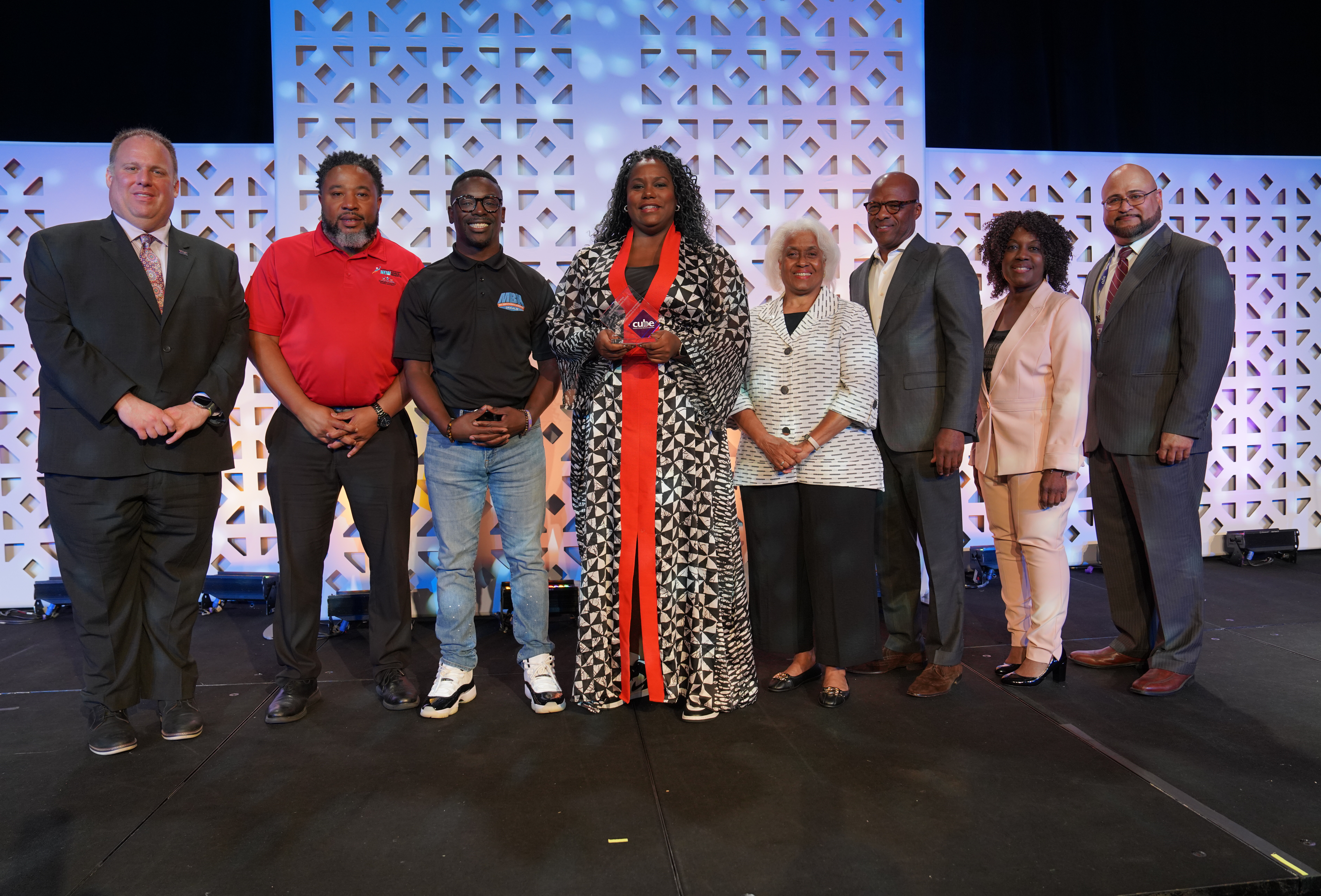
FLANKED BY FAMILY, COLLEAGUES, AND NSBA LEADERS, ERIKA MITCHELL RECEIVED THE 2025 BENJAMIN ELIJAH MAYS LIFETIME ACHIEVEMENT AWARD.
PHOTO CREDIT: NSBA
DEVELOPING LOCAL AND NATIONAL POLICIES
Receiving the award named after Mays, who joined the Atlanta Board of Education in 1969, served as its first African American president from 1970 to 1981, and was a driving force in the desegregation of the school district, is particularly inspiring, says Mitchell. “It motivates me to want to do more.”
In nominating Mitchell, Michael Wilburn, executive director of the Atlanta Board of Education, notes that she co-authored the school district’s equity policy and played a pivotal role in crafting district policies on restorative justice practices, trauma-informed practices, and domestic minor sex trafficking (DMST).
Mitchell recalls that early in her board service, during a visit to Fulton County Juvenile Courts to learn more about the needs of students involved with the justice system, she discovered that several APS students had been victims of human trafficking. Child welfare advocates explained that, as a major transit and events hub with easy connections to one of the world’s busiest airports, Atlanta consistently ranked among the top hotspots in the country for sex and labor trafficking cases. In partnership with a local nonprofit that supports vulnerable children and families, Mitchell developed the first DMST policy for any school district in Georgia. The policy included training for all APS staff so they can recognize the signs of trafficking and provide support, rather than punishment, for affected and at-risk students.
As the former chair of CUBE’S Policy & Resolution Committee, Mitchell led the development and adoption of NSBA policies and resolutions on restorative justice, trauma-informed practices, and DMST.
Mitchell also helped draft her district’s first literacy policy. Adopted in 2023 and aligned with Georgia House Bill 538, it emphasizes training teachers in the science of reading and has been instrumental in driving improvements in student literacy outcomes, writes Wilburn.
SIGNS OF PROGRESS
The rise in fourth-grade reading scores on the National Assessment of Educational Progress (NAEP), the districtwide increase in graduation rates—reaching 90.48, the highest ever for APS and surpassing the state graduation rate for the third consecutive year—and the hiring of Superintendent Bryan Johnson in 2024 are all signs of continued progress for the district, Mitchell says. With Johnson’s strong focus on academics, leadership, professional development, and willingness to pivot when strategies don’t work, she adds, “We have now moved the needle more in one year than it took other superintendents four to five years.”
A strong advocate for the district’s historic 11% pay increase for teachers and a 3%-5% cost-of-living adjustment for staff in the FY2025 budget, Mitchell says that the salary increase, the largest for teachers since 2009, was critical. “We want our teachers to be paid well so they can put 100% into the classroom for us.”
Her leadership on various APS committees, including Policy Review, Audit, and Board Development, “allows her to model effective teamwork and governance practices, ensuring that the Board works cohesively and stays focused on its mission,” writes Wilburn.
Beyond the school board, Mitchell’s leadership extends into the broader community through her service on external boards and committees, including the Board of Directors for the Atlanta BeltLine, an extensive urban redevelopment program. She is founder of Project S.E.M.S. (Sports-Education-Medical-Social Justice), a 501(c)(3) nonprofit that provides marginalized youth with vital resources, including schoolbooks and medical supplies. The former D-1 track athlete is also is the founder of Atlanta Women in Sports (AWIS), which works to recognize and advance the success of Atlanta’s women in the sports industry.
TOUGH DECISIONS
With APS’ academic leadership stabilized following several years of superintendent turnover, challenging work remains as the district tackles an estimated $100 million budget deficit. With the end of COVID-relief dollars, student enrollment shifts and declines, and audits that identified duplication of programming and positions, the district launched the Comprehensive Long Range Facilities Plan—APS Forward 2040. It aims to address overcrowding, underutilized campuses, and aging facilities for the district’s long-term sustainability, Mitchell explains.
“It’s not easy going to the community and saying, ‘We’ve got to close your school.’ People get very emotional, and I do understand,” she says. Still, hard decisions have to be made to “give us sustainable utilization of our school buildings, allow programming and funding to go directly to the schools, and enable schools to operate at their most efficient level.”
As the plan moves forward, Mitchell remains excited about the future of APS. The Phoenix rising depicted on the school district’s seal vividly symbolizes the direction of the school system that has contributed so much to the education leader’s family history and inspires her today.
“The work that I’m doing for APS is to ensure that our future generations have a better opportunity, to make sure our students receive everything they need to be successful, and that they can reach their full potential,” she says. “That’s what I lead with.”
Michelle Healy is senior editor of American School Board Journal.